Outh Carolina is bringing back firing squad.
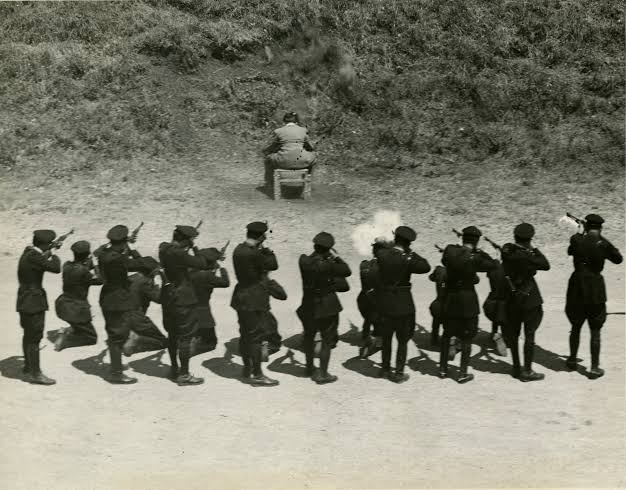
Three people are currently awaiting the death penalty in South Carolina. After the state passed a new law, those people will be forced to choose how they are executed.
In addition to lethal
injection and execution, the new law adds firing squads to the list of
acceptable methods. While that might seem like a relic of the distant
past, it is now very much a reality in 2021 South Carolina.
On May 14, South Carolina governor Henry McMaster signed S. 200 into law. He announced its signing on Twitter.
This
weekend, I signed legislation into law that will allow the state to
carry out a death sentence,” he wrote. “The families and loved ones of
victims are owed closure and justice by law. Now, we can provide it.”
Previously,
people on death row could choose between electrocution and lethal
injection. When lethal injections weren’t available, state law left
those people in limbo.
The new bill gives
people on death row a choice between lethal injection, electrocution and
firing squad for their method of execution. With lethal injection drugs
in short supply, that means people are likely to have to choose between
the latter two options. If people don’t choose a method, the state will
execute them via electric chair.
But it’s the
firing squad that has drawn the bulk of the attention around the bill.
Although South Carolina joins Utah, Oklahoma and Mississippi in using
the method as an option, nobody in the United States has been executed
by firing squad since 2010. Only four people have been executed by
firing squad since 1960—all of them in Utah.
Some lawmakers in South Carolina have raised objections. One of them is state Rep. Justin Bamberg (D- 90).
“We’re
going to force people to get electrocuted and give them the choice of
getting shot instead when that wasn’t even the law when they were
convicted of their crime,” he said.
A shortage of lethal injections drugs has had states turning to other options.
One
of the main reasons why firing squads have come back into play in South
Carolina is the lack of lethal injection drugs. In 2011, the UK-based
Dream Pharma, one of the main suppliers of lethal injection drugs,
stopped exporting the three drugs to the United States. Hospira, the
only American-based manufacturer of the same drugs, stopped making them
in 2011.
This shortage has led to states trying
a number of solutions to continue executing people. Lethal injection as
a process was developed as a more humane alternative to electrocutions
and firing squads. But the results in some places have been anything but
humane.
Officials in Texas turned to a
compounding pharmacy to make its lethal injection drugs. People who
received those drugs consistently described feeling like their insides
were burning as they died. One person writhed and shook as the drugs
coursed through their body.
The lack of drugs
is part of the reason why South Carolina hasn’t executed someone since
2011. That’s something some lawmakers say they hope changes soon.
“To
have the death penalty and then not be allowed to carry it out is
committing fraud upon the citizens we represent,” said state senator
Greg Hembree (R-28).
The state’s new law comes
at a time when the death penalty is disappearing in other parts of the
U.S. (with a major recent exception).
Despite
South Carolina’s recent law change, executions have been steadily
trending downwards in the United States for the last two decades.
Executions in the U.S. reached their peak in 1999 when 98 people were
executed. In 2020, 17 people were executed across the country.
The
federal government had all but phased out executions approaching the
latter half of the 2010s. Heading into 2020, the federal government had
executed just three people since 1963. But things took a dramatic turn
during the waning days of the Trump administration. Since July 2020, the
federal government has executed 13 people.
But
this recent shift is at odds with public opinion if, Gallup’s polls are
any indication. Support for capital punishment as a sentence for murder
has steadily trended downward over the last two decades-plus.
American’s support for executions peaked in 1994, when 80% told Gallup
they were in favor. By 2014, only 50% of Americans expressed the same
opinion.
But the last time Gallup conducted the
poll in 2019, things had changed dramatically. In that poll, only 36%
of Americans said they supported the death penalty. And more people than
at any point in modern history—42%—said they opposed the death penalty.
It’s
not just the American public that has expressed a distaste for
executions, either. President Joe Biden included abolishing the death
penalty at the federal level as part of his campaign. And while no
executions have taken his place during his young tenure in office, he
has yet to follow through on his promise to bring an end to federal
executions.
The reintroduction of firing squads comes at a time of tumult and change it the country's justice systems.
South
Carolina’s new law comes at a time when the U.S. and its states are at a
crossroads with their justice systems. A wave of new reform laws has
swept through both Democratic and Republican-controlled states. But not
all of those laws are moving their respective justice systems in the
same direction.
As states like New Mexico
elect to end qualified immunity, states like Kentucky have gone even
further in protecting police. So on some level, it should come as no
surprise that as the push to end the death penalty grows stronger, some
states like South Carolina would dig in.
Activists
have called the new law “appalling, shocking, [and] abhorrent.” But
some have suggested that the new law could shed light on the true nature
of the death penalty itself. One of those people is Robert Dunham,
director of the Death Penalty Information Center.
There
has been a sense in which lethal injection has provided a patina of
civility,” Dunham said. “It makes it appear less brutal. But the bottom
line is the intentional killing of an individual against their will is
an act of brutality. But that’s what the death penalty is. And so it
will force the American public to come to grips with whether this is
something they can stomach.”


.jpg)

%20(26).jpeg)

No comments:
Post a Comment