BLACK FEMALE SLAVE PROSTITUTION AT ITS WORSE: The Fancy Girl Trade
Who is the FANCY GIRL? And what did white men feel was her purpose?
During the time of United States Chattel Slavery of the Negro the concept of the FANCY GIRL was created.
FANCY GIRLS were LIGHT-SKINNED black women that were specifically bred and sold to be SEX SLAVES to white men.
FANCY GIRLS were also known as FANCY MAIDS and WHITE SLAVES (because of their light skin)
They
were called “FANCY” because they were dressed in fine clothes and
makeup at slave auctions to make them attractive to wealthy buyers.
FANCY
GIRLS costed double or even triple the price of an ordinary field
slave. Owning a FANCY GIRL was a status symbol for wealthy slave
owners.
FANCY GIRLS did not work in the
field. They were kept in the house to be ready for when the slave
master was ready to use them.
In some cases slave masters would rape slave women to purposely have a light-skin child to groom as a FANCY GIRL.
Some FANCY GIRLS who were sold for sex were as young as THIRTEEN YEARS OLD.
The
FANCY GIRL slave trade not only played into white male desire for
exotic sexual experiences, but it was also an integral part of the RAPE
culture in black US slavery. It played a part in the sick desire and
satiating feeling of having complete power over another human being.
Missing Florida Woman Found Inside Her Car After 9months Underwater(Pics)
The
nearly nine-month search for a missing Boca Raton, Florida woman came
to a close this weekend, thanks to Hurricane Irma preparations.
Workers
were draining the Boca Rio Canal on Saturday, ahead of the big storm,
when they discovered a car that was hidden beneath the surface of the
water.
Inside the car was the body of 47-year-old Lori Feliciano-Pino, who had been missing since December.
Lori's family learned about the discovery on Facebook, after gathering together to wait out the storm.
Lori's
sister Rosannie Feliciano says she was cooking food when the power went
out, and another sister saw a photo of the car on Facebook.
People had started commenting on the photo that it looked like the 2011 gray Toyota RAV4.
Rosannie called the detective assigned to her sister's case, but didn't get an answer so she left a voicemail.
She says she wanted to drive out to see the car, but it was 3pm and there was a curfew for the impending hurricane.
A few hours later, she says the detective called her back and confirmed that it was her sister.
He said that her belongings had been found in the car, along with the body of a woman with black hair, just like Lori's.
'I was initially completely shocked, then was very angry,' she told the Palm Beach Post.
'I can’t tell you how many times I said (to detectives) can we please check this canal because it was close to where she lived.'
The family still don't know how Lori died, but having her body is bringing them a sense of closure.
'I
feel like years would have went by if it weren’t for something horrible
like the hurricane to happen because we would never have found her,'
Rosannie said.
'Out of something tragic, something good.
Now we can start to heal and grieve.'
Lori was last seen leaving her house the night of December 19, after having an argument with her husband.
Police say her husband was never a suspect in her disappearance.
Police had nothing to go on because Lori's phone had died and there were no bank transactions to follow.
She disappeared just a week before she was due to travel north to spend Christmas with her family.
She was a mother of two and a grandmother of two.
Pictured below is Lori's car in the bottom of the Boca Rio Canal.
During the Korean War, in 1952, Margaret Bourke-White traveled with the
South Korean Army, photographing the war for Life magazine.
During
the Korean War, in 1952, Margaret Bourke-White traveled with the South
Korean Army, photographing the war for Life magazine. In these startling
images, she captured the hard, gruesome truth of war.
A
South Korean holds the severed head of a North Korean Communist
guerrilla by the hair as a member of the South Korean National Police,
smiles broadly, with an axe over his shoulder, Cholla Poktuk, South
Korea, November 17, 1952.
• She
spent nine months there, traveling through the wilderness, surviving
typhoons, gunfire, and ambushes, and photographing guerilla warfare.
This
terrible device was used in most of Europe throughout the Middle Ages.
It was a very simple instrument that was used to tear a victim's skin
apart.
The victim would be naked and tied
leaving him or her completely helpless. Then the torturers began the,
sometimes public, act of mutilation. They often began with the limbs and
slowly moved on to the chest, back, neck and finally the face.
In
short, the Spanish Tickler or Cat's Paw, is nothing but an extension to
the torturer's hand, it had spikes which were sharp enough to tear
through anything in their path.
This instrument
was very common in Spain, mostly during the Spanish Inquisition,
although its use in France and England is well recorded, they often
adopted different torture methods.
The Spanish
Tickler varied in shape and size. Some were long and had a pole attached
to the rear so the torturer could tear the skin from a distance while
others were nothing but the claw itself. Depending on the instrument,
the torture varied. This torture often resulted in death but some of the
victims were spared or convicted to a shorter torture
session.~Wicked&Depraved
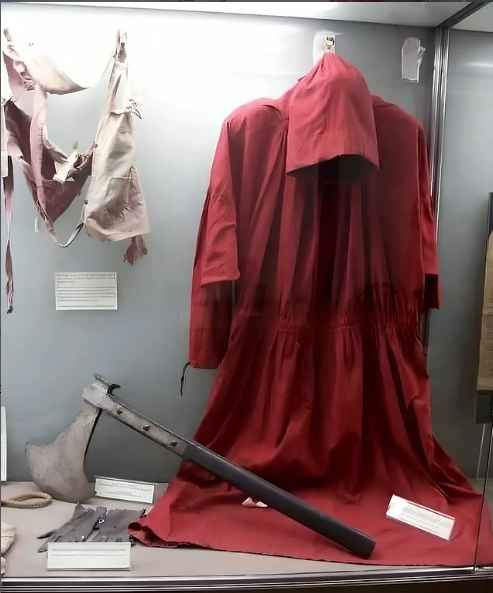
The robe and axe of the executioner Giovanni Battista Bugatti, who was
the executioner for the papal States from 1796 to 1864. He executed 514
people during his time as an executioner
The
robe and axe of the executioner Giovanni Battista Bugatti, who was the
executioner for the papal States from 1796 to 1864. He executed 514
people during his time as an executioner.
Bugatti
specialised in hanging, beheading and malleting the condemned
prisoners. He retired at 85 and was an executioner as a part-time job,
but sold umbrellas and other souvenirs to tourists as his main job in
Rome. He died in 1869. His role as an executioner lasted for 68 years
and 148 days.
As
it is more unknown, here is what Malleting is. It is a form of
execution that was reserved for the most loathsome crimes. A prisoner is
brought to the execution scaffold and is hit in the head with a large
mallet. This usually knocked the prisoner unconscious, and then their
throat would be slit. It was discontinued in 1806 for its brutality.
Doctors Remove 150 Live Bugs From Florida Man's Nose
Dozens and dozens of larvae were reportedly feeding on the man's nose and sinus cavity — some as big as the end of a pinkie.
A Florida man is breathing easier now that 150 live bugs have been removed from his nose.
The
unidentified patient went to a hospital earlier this month after
noticing that his whole face felt like it was on fire, according to a
Friday report by Jacksonville’s First Coast News.
Although the man first started experiencing symptoms in October, it wasn’t until recently that they became serious.
“Over
a couple hours my face just started swelling, my lips swelled, I could
hardly talk,” the patient told First Coast News. “I couldn’t even get up
to go to the bathroom without my nose starting to bleed.”
The
man visited HCA Florida Memorial Hospital in Jacksonville and consulted
with Dr. David Carlson, an ear, nose and throat specialist who was on
call.
Carlson was shocked when he looked inside
the man’s nose with a camera. He saw dozens and dozens of bugs feeding
on the nose and sinus cavity ― some as big as the end of his pinkie.
“I
knew he was in big trouble, there was erosion that was occurring near
the skull base in very close proximity to his eye and his brain,”
Carlson said.
At first, the physician tried
using suction to remove the insects, which were in the larval stage. But
they were too large, so he had to extract them one by one from the
man’s nose.
“They were right up against his
skull base, right under the brain, had they gone through that it could
have killed him,” Carlson said.
The bugs have since been sent to an epidemiologist to determine their species. The patient is expected to make a full recovery.
It
remains a mystery how the larvae got inside the man’s nose, but he told
First Coast News that the problem might have stemmed from his bad
hygiene habits when handling dead fish.
“Before
I would rinse my hands in the river, now I’ll use cleaner to do a
better job and not touch my nose or my hand,” the man told the station.
Teenage boy who complained of headaches shocked doctors with something much worse
If
we needed concrete proof of the fantastic progress of medicine over the
years, this is it. In India, doctors have indeed saved a young boy’s
life by performing extremely complex surgery. And what a surgery: they
had to remove an enormous cyst from the boy’s head. The meticulous
surgery was a success.
Discover our latest podcast
The shocking size of the cyst
The
14-year-old boy had been complaining about headaches and vomiting for
some time. Far from a simple hangover, the young man actually had a
fist-sized cyst located inside his skull! One can only wonder how his
brain was able to resist such a protuberance.
Taken
straight to the hospital for an emergency MRI, the scan revealed the
presence of the gigantic cyst. After analysis, doctors diagnosed the
teenager with an echinococcal disease. A disturbing disease, to say the
least.
Echinococcosis: an explanation
Indeed,
this disease comes from a parasite, a tapeworm of the genus
'echinococcus'. The doctors then resorted to a craniotomy, they drilled a
small hole inside his skull and removed the cyst.
This
very complex operation was successfully carried out by the surgeons.
They delicately separated the cyst from the brain, trying not to take
out a piece of grey matter along with the abscess.
A
14-year-old boy who lived on a farm presented with episodic headaches
associated with vomiting. MRI showed a large, multiloculated cyst in the
brain, and a craniotomy (shown in a video) was performed to excise it.
A successful operation!
Fortunately,
the operation went perfectly. The young boy was able to return to
school and resume his activities as normal after a two-week recovery
period.
According to the World Health
Organization (WHO), more than one million people are affected by
echinococcosis in the world. Carried by certain animals such as dogs,
the tapeworm can transmit this parasitic disease to humans, either by
ingesting parasite eggs present on food or in contaminated water.
A parasite transported by certain animals
As
WHO explains on its website, we can also contract this disease 'after
direct contact with animal hosts'. Knowing that the cysts produced by
this parasite develop slowly in the body, it is necessary that they
reach a certain growth before developing symptoms likely to alert us.
Infected
individuals may therefore be 'asymptomatic' for many years. Eventually,
they will experience vomiting and coughing due to the growth of the
abscess.
This article has been translated from Gentside FR.
Sources used:
The Sun: 'Shocking images show doctors remove cyst the size of a fist from teen’s brain'
2 Indonesian Women Publicly Whipped 100 Times Each For Sex Work
Two
Indonesian women have been publicly whipped nearly 100 times each for
selling sex workers' services online, an official in the country's
conservative Aceh province said on Tuesday.
Aceh,
at the tip of Sumatra, is the only region in Muslim-majority Indonesia
to impose Islamic sharia law, which allows flogging for a range of
offences including prostitution, gambling, adultery, drinking alcohol,
and gay sex.
The punishment was handed down on
Monday in Langsa city where dozens gathered to watch the pair get
lashed, despite bans on crowds over coronavirus fears.
Neither of the women wore disposable face masks, unlike in some other recent whippings.
The
two hijab-wearing suspects were arrested in March along with five sex
workers, who could also face a flogging if found guilty of violating
Islamic law, said Aji Asmanuddin, head of Langsa's Islamic sharia
agency.
"They were punished for violating sharia by advertising (sex) through the internet," Asmanuddin said.
Officials were struggling to crack down on the area's booming online sex trade, he added.
"This is the first (pimping) case in Langsa although we believe there are many of them out there," Asmanuddin said.
"We just don't have the necessary tools to monitor them online."
Rights groups have slammed public caning as cruel, and Indonesia's President Joko Widodo has called for it to end.
But the practice has wide support among Aceh's mostly Muslim population.
Mom dies pregnant the next day her sister visits her grave & got shocked
Mom
dies pregnant. The next day, her sister visits her grave and gets
shocked. A shocking moment in a recently surfaced video captured a
deceased pregnant woman gave birth to a baby in her grave. A dead woman
could give birth two ways to a live child. The first is after a brain
death.
Sometimes bodies with life support can
continue to function even after doctors pronounced brain death. There
was a case that made the news recently about a woman who gave birth to a
healthy child after being pronounced brain dead. The other is via
Csection. Very soon after the death of the mom. When the mom stops
breathing, the baby, which receives oxygen from mom’s blood, also starts
to die.
Death from lack of oxygen can be very
fast. There is a very narrow window between mom’s death and fetus’death
where a baby could potentially be born. If we assume that giving birth
just means having a child, then a woman could have a baby via a
surrogate after her death, potentially many years after her death if she
froze OVA during her lifetime. Postmortem deliveries Where a woman has
died and a live infant is birth, vaginally is extremely rare. One case
where there was a woman that killed herself during active labor and the
baby was delivered.
There is controversy. If
the woman still had a heartbeat, so would not be considered a post
mortem delivery. The baby gets oxygenated blood from its mother through
the umbilical cord when the mother stops breathing, which is what
happens when she dies. The fetus quickly runs out of oxygenated blood
too, and it dies too. This will happen within a few minutes after the
mother’s heart stops.
If a pregnant woman dies
at say at least seven months gestation, the baby would have to be cut
out of the woman’s body immediately and quickly. If pulled out quickly
enough, the baby might survive. In some cases, a woman has been kept on
life support with an artificial heartbeat and oxygen in order to give
the fetus time to develop enough to survive, and then they pull the plug
on the dead mother. Losing a loved one is without a doubt one of the
most difficult ordeals in a person’s life. Even more so if the death
involves a baby, it was most certainly a difficult time for that family
and especially her sister, who decided to visit her grave and put some
flowers.
But there was another shocking
accident. What a crazy world. A rural community in Eastern Cape is
stunned and baffled after a dead woman gave birth inside a coffin. The
bizarre coffin birth has left some people crying witchcraft after a
deceased 33 year old mother of five. Nom Valiso, no Masonto Madoy
Matheisi Village.
The best part of life is
dying to the past and getting reborn to the present. Nature of mind is
emptiness, but we keep on gluing so many stuff complexity that we forgot
to live the moment fully. Death gives realization that everything is so
temporary and it has to end anyways. So why to waste time in becoming
unhappy sorrow? Why don’t we just share and care and make others’lives
better?
All your enemies are going to die
anyway, so why bother about them so much? A woman named Noveliso from
South Africa had complained of breathlessness for a couple of days,
after which she suddenly passed away. She was the mother of five other
children at her home in the village of Matthiasi in South Africa’s
Southern Cape Province, as presented by family members. She neither nor
anyone else was aware that she was pregnant before her death, so it came
as a big surprise to find a baby. After ten days she had died.
The
mother’s organism is programmed in such a way to ensure that the baby
survives even if the mother had passed away. In this specific case, even
if the baby which was born was still alive, its health could have been
affected by the mother’s illness which caused her death.
Either
way, the cold temperature within the mortuary, which is used to not
allow corpses to start decaying, is what most probably killed the baby.
There is no need for the mortuary to be checked as the people inside the
fridge are dead, and no one would have expected a baby to be born out
of a dead mother. The family of the deceased mother had been devastated
by this news.
Some of the elder siblings
believed that it had something to do with witchcraft. The mother had
been buried with her deceased newborn. The company offering funeral
services assured to check from now on and to ensure if the deceased
person is pregnant in order to avoid such cases in the future. This is
truly a unique case. Is it possible to give birth after death?
The
question that everybody had been asking after this case had gone viral
was whether it would be possible for someone who had died to give birth,
especially after so many days. What many call coughing birth is
medically known as postmortem fetal extrusion. It occurs during
decomposition of the body, when tissues become depleted of oxygen and
gases such as carbon dioxide and methane are released, as medical
experts explained. At the same time, organ tissues are weakened and the
mix of the gasses and weakened tissues causes the torso and limbs to
become bloated. A few days after death, gas in the abdomen may cause the
uterus to prolapse and the fetus to be expelled from the body.
However,
as experts have stressed, there have been no records of a baby
surviving following a coffin birth. How did the girl’s family react to
the news? A fresh Tragedy While rare, it does happen, and the staff
workers at the funeral directors have noted that in their more than 20
years experience, they’ve never heard of a dead woman giving birth. The
case baffled many who came across the story. Even the family of the 33
year old woman.
However, what might have
shocked and stunned them at first, it had soon left the family of the
woman even more grief stricken, especially her 76 year old mother.
Mandesla Medaue Woman’s Mother Speaks Out Having just gone through the
stress of losing her daughter and unborn grandchild, the 76 year old
then had to learn that the baby was in fact in a way born.
But
of course it was still born. Speaking with the media, she said that she
wants educated people, once you know better, to help cool down their
emotions and explain to them how it was possible for a dead woman to
give birth. She told them that she is now over 70 and has never heard of
such a thing and asked why such a thing was happening to her child.
Witchcraft
the cause of all the grief in the Eastern Cape or where the family are
from? In recent years, there had been many crimes and death related to
suspected witchcraft. Even as recently as March 2020, an elderly woman
was drowned in her village after local men has suspected her of
witchcraft. As a result of this, many elderly people have been
relocating from their villages in fear of meeting the same fate. Those
who believe in witchcraft had suggested to Noma Valiso’s family that
maybe it was that that led to their dead daughter giving birth ten days
after passing.
Though, as the Daily Mail had
reported, they had ignored those suggestions. The funeral also despite
the suggestions to take precautions with the body in case that it was
all a result of witchcraft, the family went ahead with the funeral. The
mother and child were laid to rest in one coffin, which was later
cremated. There had been no further updates about the gender of the baby
and whether the family had decided to name it. In addition, while this
story might sound unbelievable, there had been some cases of women who
had passed away with the help of medicine, bringing their pregnancies to
term and giving birth to healthy babies.
It’s
not clear whether the baby’s life could have been saved and doctors
provide a different treatment when the mother fell ill. Children born
123 days after mother declared brain Dead Medical science has progressed
so much that it managed to keep alive a brain dead pregnant woman for
123 days before delivering her twins via an emergency Csection.
Back
in 2017, the story of 21 year old Franklin Dasilva Sampleini Padilla
from Brazil, had caught the attention of heartstrings of internet users.
The woman was pronounced brain dead after suffering a stroke while nine
weeks pregnant. The doctors and the woman’s fiancee decided to keep the
woman on a ventilator to save the nine week old embryos after their
hearts continued to beat inside their mother’s womb.
Their
father, Muriel Padilla, had described the birth of his children as a
miracle after the doctors made it clear to him that they had no hope of
the living ones surviving. The twins, a boy and a girl, were born at
seven months and kept in incubators for three more months before being
given the all clear and being discharged from the hospital.
Woman
brain dead for three months, gives birth to baby A similar situation
took place across the Atlantic in Portugal back in 2019. International
sportswoman Katerina Sakura had suffered an asthma attack when she was
19 weeks pregnant and was put into an induced coma. However, her
condition deteriorated and within days the doctor had declared her brain
dead.
On this date, June 18, 1947, six convicted Japanese war criminals were hanged by the U.S. Navy War Crimes Commission on Guam
THE HANGING OF SIX JAPANESE WAR CRIMINALS (JUNE 18, 1947)
On this date, June 18, 1947, six convicted Japanese war criminals were hanged by the U.S. Navy War Crimes Commission on Guam.
Admiral Shigematsu Sakaibara (seated third from left) signing the surrender of Wake Island aboard USS Levy - 4 September 1945. Admiral Shigematsu Sakaibara (seated third from left) signing the surrender of Wake Island aboard USS Levy - 4 September 1945.
Surrender of Wake Island Aboard USS LEVY DE 162
4 September 1945
Left to right, sitting at table: Japanese Army Colonel Shigeharu
Chikamori, Sakaibara, Japanese Paymaster Lieutenant P. Hisao Napasato,
Marine Brigadier General Lawson H. M. Sanderson, of Santa Barbara, Cal.,
Commander of the Fourth Marine Air Wing who accepted the surrender in
the name of Rear Admiral W. K. Harrill, Army Sergeant Larry Watanabe of
Honolulu, official interpreter at the surrender, and Colonel T. J.
Walker Jr., Sanderson's Chief of Staff.
A native of Yamagata prefecture in northern Japan,
Sakaibara was a graduate of the 46th class of the Imperial Japanese Navy
Academy in 1918, placing 36th in a class of 124.
He served his midshipman tour on the cruiser Tokiwa, and after his commission as an ensign was assigned to Hirado. He later served on the destroyer Kaba and battleship Mutsu.
As a sub-lieutenant he served on the Iwate and after his promotion to lieutenant on December 1, 1924, he was assigned to the Hiei, Yura, and Sendai. He was chief gunnery officer on the Tatsuta. Promoted to lieutenant commander in 1930, he served as chief gunnery officer on Takao in 1934, followed by Mutsu in 1935. He was executive officer on Chikuma in 1939. After his promotion to captain in 1940, he served in a number of staff positions.
After
the Battle of Wake Island on December 23, 1941, Sakaibara was appointed
garrison commander of the Japanese occupation force. Fearing an
imminent attempt by American forces to retake the island, Sakaibara
enslaved the American prisoners of war and forced them to build a series
of bunkers and fortifications.
However, instead of attempting an amphibious invasion, the United States
Navy established a submarine blockade, causing the Japanese garrison to
starve. United States forces bombed the island periodically from 1942
until Japan's surrender in 1945.
On October 5, 1943, aircraft from USS Yorktown bombed Wake Island.
Two days later, fearing an imminent invasion, Sakaibara ordered the
execution of the 98 civilian prisoners remaining on Wake Island. They
were taken to the northern end of the island, blindfolded and
machine-gunned. One prisoner (whose name has never been discovered)
escaped, but was recaptured and personally beheaded by Sakaibara.
Sakaibara was promoted to rear admiral a year later, on
October 15, 1944. The Japanese garrison on Wake Island formally
surrendered to the United States on September 7, 1945.
After the war, Sakaibara was taken into custody by the
American occupation authorities, extradited to Guam, and sentenced to
death by a military tribunal for war crimes in connection with his
actions in the "Wake Island Massacre". He was hanged on June 18, 1947.
Until the end, he maintained.
A s*ic*de attacker lies on the ground after his vest was defused in
Jalalabad province, on June 30, 2013. Afghan security forces captured
the would-be attacker before he was able to blow himself up.
A suicide blast outside an election commission office in the eastern Afghan city of Jalalabad has killed at least seven people and wounded several others, sources told Al Jazeera.
The
target of Saturday’s attack appeared to be a protest camp in Nangarhar
province, where a group of people were rallying in support of a
candidate disqualified from parliamentary elections due to take place in
October.
Attaullah
Khogyani, a spokesman for the provincial governor, said the blast
happened when supporters of the disqualified candidate were trying to
shut down the election commission office.
“We
had requested the protesters to stop their demonstrations because they
could be targeted by fighters but they rejected our security message,”
said Khogyani.
August has already been a bloody month in Afghanistan with the Taliban increasing attacks on security forces across the country and the Islamic State of Iraq and the Levant (ISIL, also known as ISIS) group targeting the capital Kabul, with hundreds killed according to estimates.
A
witness told AFP news agency that the blast was caused by a suicide
bomber detonating near a tent full of protesters and that security
forces had cordoned off the area.
“It
was a huge blast and it shook our home,” said Mirza Amin, who added he
lived 50 metres from the site of the blast. Earlier this month, a
suicide bomber blew himself up outside an Afghan election office inKabul when protesters gathered to challenge the commission’s decision to disqualify 35 candidates.The blast comes nearly a week after PresidentAshraf Ghanioffered a conditional three-month ceasefire to theTaliban, a move welcomed by the United States andNATOafter nearly 17 years of war.
British Royal Marine poses with two decapitated heads during the Malayan Emergency.
This
photograph was first published on May 10, 1952, by the British
Communist newspaper the Daily Worker (Morning Star), in a frontpage
article titled "This Horror Must End". This article was a response to
British government claims that similar headhunting photographs
previously published by the Daily Worker depicted isolated incidents.
• The
heads show signs of torture, as many of the teeth are missing. The
decapitation of suspected socialists and pro-independence fighters was a
common practice by British allied forces during the Malayan Emergency,
typically done by Iban headhunters hired by British forces.
25 Historical Pictures Of Women Who Had The Ovaries To Take On Life
1.The
Australian Annette Kellermann (professional swimmer, writer, and
vaudeville performer) was one of the first women to wear a one-piece
swimsuit and proudly pose while doing so... but some thought it was
inappropriate and Kellermann was arrested for indecent exposure in 1907
2.Members of the first ever female basketball team in 1902.
3.Suffragists Annie Kenney and Mary Gawthorne painting on the pavement for women's right to vote in 1907.
8.Gertrude Ederle, the first women to swim across the English Channel.
9.In 1928, Amelia Earhart became the first woman to fly solo across the Atlantic Ocean.