LONGEST EXECUTIONS IN HISTORY.
Some of these killings took hours, others days, and some even weeks. Here we look at seven of history’s most interminable terminations, with examples of extended executions, and stories of savagely spun-out slayings
Hang 'em High: 7 of history's most famous executioners
1. A Cut Above the Rest – Slow Slicing
In Imperial China, serious crimes such as murder and treason saw some wretched people sentenced to Lingchi.
Also known as ‘death by a thousand cuts’ or ‘slow slicing’, Lingchi involved the condemned having small pieces of flesh removed with a knife in a manner that would delay death. The number of slices could be just a handful or could number in the thousands.
2.Slow Roast – Boiling and Burning Alive
Many of the most unhurried and cruellest executions in history have involved the condemned being steadily cooked in some way (though not normally with consumption in mind!).
In 1532, chef Richard Roose was boiled to death in Smithfield, London, for the crime of poisoning. He was chained to a gibbet and repeatedly dipped into a boiling cauldron, dying after two hours.
3. Brickin’ It - Immurement
From the Vestal Virgins of Ancient Rome to 19th-century Persia (where criminals were known to have been bricked up alive into city walls head downwards) the ‘walling in’ of the condemned has a long history.
The Vestal Virgins, immured in an underground chamber when breaking their vows, were given a small amount of food and water to take into their tomb. It is not known how long some of them may have lasted – perhaps days or even weeks.
The execution methods used in number 5 and 7 are just too horrible.. See comment
The execution methods used in number 5 and 7 are just too horrible.. See more
KILLING ME SLOWLY: 7 OF THE LONGEST EXECUTIONS IN HISTORY

Today, if you are unlucky enough to be sentenced to death,
in many parts of the world you would have the small consolation that it
would be (most of the time) swift – firing squad,
electrocution, hanging, or lethal injection.
For much of history, though, many people suffered protracted, agonising,
drawn-out deaths. Some of these killings took hours, others days, and
some even weeks.
Here we look at seven of history’s most interminable terminations, with
examples of extended executions, and stories of savagely spun-out
slayings.
Hang 'em High: 7 of history's most famous executioners
1. Brickin’ It - Immurement

From the Vestal Virgins of Ancient Rome to 19th-century
Persia (where criminals were known to have been bricked up alive into
city walls head downwards) the ‘walling in’ of the condemned has a long history.
The Vestal Virgins, immured in an underground chamber when breaking
their vows, were given a small amount of food and water to take into
their tomb. It is not known how long some of them may have lasted –
perhaps days or even weeks.
That was two thousand years ago. One notable case of this sinister
method of execution was barely more than a century ago. Moroccan
shoemaker Hadj Mohammed Mesfewi endured a slow, lingering death in June
1906 for the murder of 36 women.
Into the thick walls of the central bazaar in Marrakesh, workers made a
recess just big enough for a man stand up in. In front of a baying mass
of locals, Mesfewi was dragged kicking, fighting, and screaming into the
cavity, where it was then sealed up with stonework.
For two days (presumably, there were air holes, to prolong the
suffering) his intermittent screams could be made out through the
masonry, each one eliciting a cheer from the crowd outside.
After three days the screams stopped.
2. Nailed it – Crucifixion
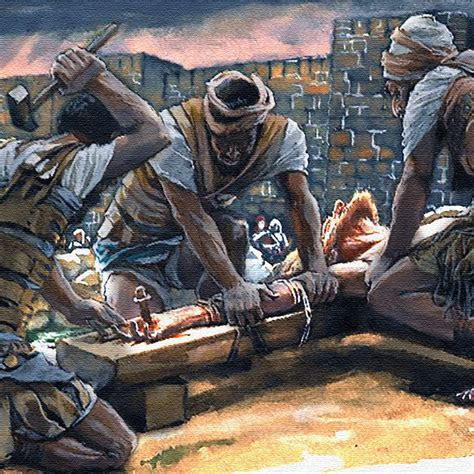
The Third Servile War (73-71 BC), known popularly as the
Spartacus Rebellion, was a slave revolt against Rome famously led by
Thracian gladiator Spartacus (111-71 BC).
It has been estimated that after their defeat some 11,000 men of the
slave army were crucified, over half of these by victorious general
Marcus Licinius Crassus (115-53 BC), who had POWs nailed to crosses
every 40-60 yards along the whole 120 miles of the busy Appian Way from
Capua to Rome.
Many of the rebels reportedly took several days to die, and indeed
crucifixion was a notoriously slow method of capital punishment. Its
most famous single victim, Jesus Christ, spent about six hours on the
cross before succumbing, according to the Bible.
It was common however for a victim of crucifixion to last two or three
days, depending on how much torture they were subjected to before being
hoisted onto the cross, and whether a mercy blow, a coup de grâce, was delivered.
Typically, prisoners were first stripped naked in front of onlookers,
then scourged. This resulted in serious injuries, and many didn’t make
it past this stage. Next, they were forced to carry the cross to the
site of their crucifixion.
The period for survival on the cross ranged from under half an hour to
four days, depending on the method. Often, robbers would just be tied to
the cross, so could last a good number of days. Others were fixed to
the cross with their arms positioned in such a way as to be virtually
impossible to breathe, dying in as little as ten minutes.
One story tells of a husband and wife in AD 213 who were said to have
endured crucifixion for an incredible ten days before snuffing it.
3. A Cut Above the Rest – Slow Slicing

In Imperial China, serious crimes such as murder and treason saw some wretched people sentenced to Lingchi. Also known as ‘death by a thousand cuts’ or ‘slow slicing’, Lingchi involved
the condemned having small pieces of flesh removed with a knife in a
manner that would delay death. The number of slices could be just a
handful or could number in the thousands. The ‘slow process’ could be
over quite quickly or could last days.
After photos surfaced in 1905 of a prisoner being ‘slow sliced’ the penalty was prohibited.
Perhaps the slow-slicee who endured the longest carving was corrupt
eunuch Liu Jin (1451-1510). A cunning court official of the Ming
dynasty, he was accused of plotting a rebellion against the emperor.
Persuaded of Liu Jin’s guilt, the emperor ordered him to be executed by Lingchi in a most protracted manner. Liu Jin was diced up over a period of three days and reportedly suffered 3,357 cuts before dying.
At the conclusion of his punishment morsels of Liu Jin’s flesh were
bought and eaten by Beijing locals who had experienced oppression at the
hands of the unscrupulous courtier.
4. Slow Roast, Anyone? – Boiling and Burning Alive

Many of the most unhurried and cruellest executions in
history have involved the condemned being steadily cooked in some way
(though not normally with consumption in mind!).
In 1532, chef Richard Roose was boiled to death in Smithfield, London,
for the crime of poisoning. He was chained to a gibbet and repeatedly
dipped into a boiling cauldron, dying after two hours. This continual
scalding was done to maximise the suffering – their skin would pop and
blister horribly from the burns, causing severe pain, before it was
mostly bones that remained.
Although he was likely beheaded, tradition has it that deacon of Rome
Saint Lawrence (AD 225-258) was bumped off by being barbequed. The
prefect of Rome, angered by Lawrence, had a gridiron placed over a large
fire and Lawrence bound to the top of the gridiron. After enduring the
searing heat from below, he was reported to have remarked to his
executioners: ‘I am cooked on that side; turn me over, and eat.’
György Dózsa (1470-1514) was a Transylvanian knight who led a failed
rebellion against the country’s nobility. The authorities decided to
make a gruesome example of Dózsa.
First, he was forced to sit on a red-hot iron chair, his ‘throne’, and
then a red-hot crown and sceptre were placed on his head and hand
respectively. Next, smoking hot pincers were used to tear holes in his
skin and, his co-conspirators, who had been deliberately starved by the
jailers, were forced to sink their teeth into Dózsa and eat his sizzling
flesh.
The accounts of Dózsa’s ordeal suggest that it went on for some time
before he finally breathed his last, though it cannot be determined
exactly how long it was.
5. This is a Stick Up! - Impalement

In his 1798 book, Voyages to the East-Indies, Johan
Splinter Stavorinus relates how impalement was a common method of
capital punishment in the Dutch colony of Batavia (modern-day Jakarta,
Indonesia).
He describes witnessing a slave being impaled for murder there in 1769.
An incision was made in the man’s spine, he says, and then an iron spike
was driven under the skin along the length of the spine before coming
out at the base of the neck between the shoulder blades. The iron spike
was then hammered into the ground and the prisoner left there. The
vibration occasioned by the hammering-in made the man scream in pain,
Stavorinus says. A guard prevented anyone from passing food or drink to
the poor man.
Stavorinus says that this victim lasted until the next day, but that
there had been cases of others being skewered for ‘eight days or more’
before expiring.
6. Milking It - The Boats, The Dread of the Ancient World

Everyone knows what it’s like to have too much to drink at a
party and say something daft. Normally all it garners is a cross word
or two in the taxi home. But for Persian soldier Mithridates, the
consequence for his outburst at a boozy banquet in 401 BC – which put
him in the bad books of King of Kings Artaxerxes II (453 or 445 – 358
BC) - was to suffer one of the most barbaric punishments in human
history – scaphism, otherwise known as ‘The Boats’.
Tied to a boat on a stagnant pool, the victim is force-fed milk and
honey until they vomit and vacate their bowels. Then they are basically
eaten alive, from the inside, by insects and other vermin.
Mithridates was reported to have endured ‘The Boats’ for 17 days before dying.
7. The Orléans Robber and The Three-Year Execution
One day in 1747, in the French city of Orléans, a highwayman was ‘broken’ on the wheel.
After bludgeoning the man to a bloody pulp, the executioner gave what he
believed to be a mangled corpse to a local surgeon. Preparing to
dissect the ‘body’ for a lecture, the physician and his students were
shocked to see the man come round.
The surgeon, after amputating the man’s legs and one of his arms,
smuggled him to a rural area hundreds of miles away from Orléans, where
he was to live in the woods and make a living as a beggar.
After the robber had attempted to murder a local farmer
with an iron bar, a magistrate sent soldiers to investigate the
mendicant mugger’s wooded hideout. There they discovered accomplices and
a secret cave, where they found child captives held there for three
years. It was stated that the cave’s floor was full of the bodies of the
robbers’ victims.
The highwayman was again sentenced to die on the wheel. This time he
would not survive. Bound to the wheel by his torso and one arm, for five
days he lived in agony on the wheel before succumbing to an execution
with a three-year hiatus.


.jpg)

%20(26).jpeg)

No comments:
Post a Comment