Thanks for visiting. You are dearly welcome

7 Nigerian Historical Facts That Sound Fake But Are Actually True 🇳🇬

Image
7 Nigerian Historical Facts That Sound Fake But Are Actually True 🇳🇬 7 Nigerian Historical Facts That Sound Fake But Are Actually True 🇳🇬 Introduction Nigeria has one of Africa's richest and most fascinating histories. From powerful ancient kingdoms and colonial rule to independence, military governments and the birth of the modern Nigerian state, the country's past is filled with stories that can sometimes sound unbelievable. Some historical facts are so surprising that you might think they are myths—until you check the records. For today's World Best Historical Events history series, here are 7 Nigerian historical facts that sound fake but are actually true. 1. Nigeria Was Not Always One Country Today, Nigeria is one country made up of 36 states and the Federal Capital Territory. But the political entity known as Nigeria was created through colonial administrative changes. In January 1914, Britain's colonial administration amalgamated the Northern and Southern Pr...

Longitude and Transverse Impalement


 Longitude and Transverse Impalement


Longitude and Transverse Impalement

Impalement is one of the earliest forms of execution, use from the second millennium BC. Impalement by deliberately driving a stake or pole into the body took two forms: longitudinal and transverse. Longitudinal impalement went through the anus and came up near the head through the chest or shoulder blades while transverse impalement pierced the victim horizontally through the torso: either front to back or vice versa.

The code of Hammurabi, a Babylonian law code written around 1772 BC records one of the earliest crimes punished by impalement: a woman convicted of killing her husband, for the sake of another man. Even without the killing, adultery seems to have attracted impalement as a penalty in other areas of ancient Mesopotamia.

But the punishment was also used as a very subtle form of mind control. It was common in the Assyrian and Neo-Assyrian empires to impale the troops and generals of defeated foes in front of their countrymen- probably as a warning against potential future rebellions. Such acts acted as a gruesome form of muscle flexing, a way of reminding the conquered that they had been bested – and to ensure they did not forget this. This explains why monarchs such as King Ashurnasirpal II in the ninth century BC recorded their atrocities on the Nimrud Reliefs.

The Ottomans also practiced impalement, especially during the insurgence of Greek resistance against their Turkish overlords in the late eighteenth and early nineteenth century. It became common to display the impaled bodies of Greek rebels in local villages, to dissuade any form of support to future revolts by the villagers.

However cruel it may have been, impalement did send a compelling message. The impaled bodies of thousands of Turks planted along the river Danube in the 1640s on the orders of Vlad III, Prince of Wallachia, otherwise known as Vlad the Impaler, helped persuade the invading Turkish sultan to retreat.

Meanwhile, Europeans living in Persia and Syria, during the seventeenth and eighteenth centuries reported a relatively low incidence of the type of crime punishable by impalement. Frenchman Aubry de La Motraye claimed in the 14 years he lived in the Persian empire, he hadn’t heard of above 20 thieves impaled and only six highway robbers, while Alexander Russell, who lived in Aleppo between 1740 and 54 reported only half a dozen public executions in that time.


Comments

Check out our popular viral post

She Suspiciously Paid For Everything In Cash For Years, Then People Realized Why.

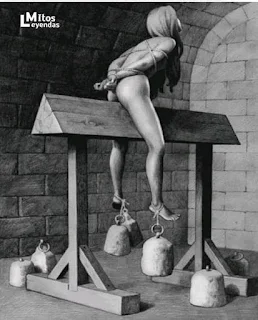
"Wooden Horse or Spanish Donkey"

SHAME AND DISGRACE! THIS IS A UNACCEPTABLE IN OUR LAND