Top Pictures That Shocked The World
It
has often been said throughout time that a picture is worth a thousand
words. Any picture may be worth a thousand words, but only a few rare
photos tell more than a thousand words. They tell a powerful story, a
story poignant enough to change the world and galvanize each of us. Over
and over again…
From the iconic images of Omayra Sanchez’s tragic
death to the horrifying images of the Bhopal Gas disaster in 1984, the
power of photography is still alive and invincible.
Here is my top list of photos that shocked the world:
Be prepared for images of violence and death (in one case, the photograph of a dead child) if you scroll down.
Thailand Massacre (Neil Ulevich)
Neal
Ulevich won the 1977 Pulitzer Prize for a 'series of photographs of
disorder and brutality in the streets of Bangkok,.Thailand"
(Pulitzer.com)
The Thammasat University Massacre took place.on October 6, 1976.
It
was a very violent attack.on students who were demonstrating against
Field Marshall Thanom Kittikachorn. F.M. T. Kittikachorn was a dictator
who was planning to come back to Thailand. The return of the military
dictator from exile provoked very violent protests. Protestors and
students were beaten, mutilated, shot, hung and burnt to death.
1. Kosovo Refugees (Carol Guzy)
Carol
Guzy, the first woman to receive a Pulitzer Prize for spot news
photography, received her most recent Pulitzer in 2000 for her touching
photographs of Kosovo refugees.
The above picture portrays Agim
Shala, a two-year-old boy, who is passed through a fence made with
barbed wire to his family. Thousands of Kosovo refugees were reunited
and camped in Kukes, Albania.
2. War Underfoot (Carolyn Cole)
Los
Angeles Times photographer Carolyn Cole took this terrifying photo
during her assignment in Liberia. It shows the devastating effects of
the Liberian Civil War.
Bullet casings cover entirely a street in
Monrovia. The Liberian capital was the worst affected region, because it
was the scene of heavy fighting between government soldiers and rebel
forces.
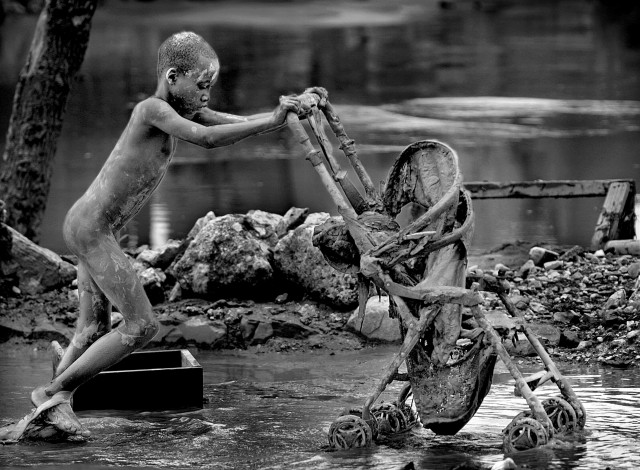
After the Storm (Patrick Farrell)
Miami
Herald photographer Patrick Farrell captured the harrowing images of
the victims of Haiti in 2008. Farrell documented the Haitian tragedy
with impressive black-and-white stills. The subject of “After the Storm”
is a boy who is trying to save a stroller after the tropical storm
Hanna struck Haiti.





Comments
Post a Comment